- 24/7 Industrial Support Available
- +86(512)58990319
- vp@jsxtbkj.com

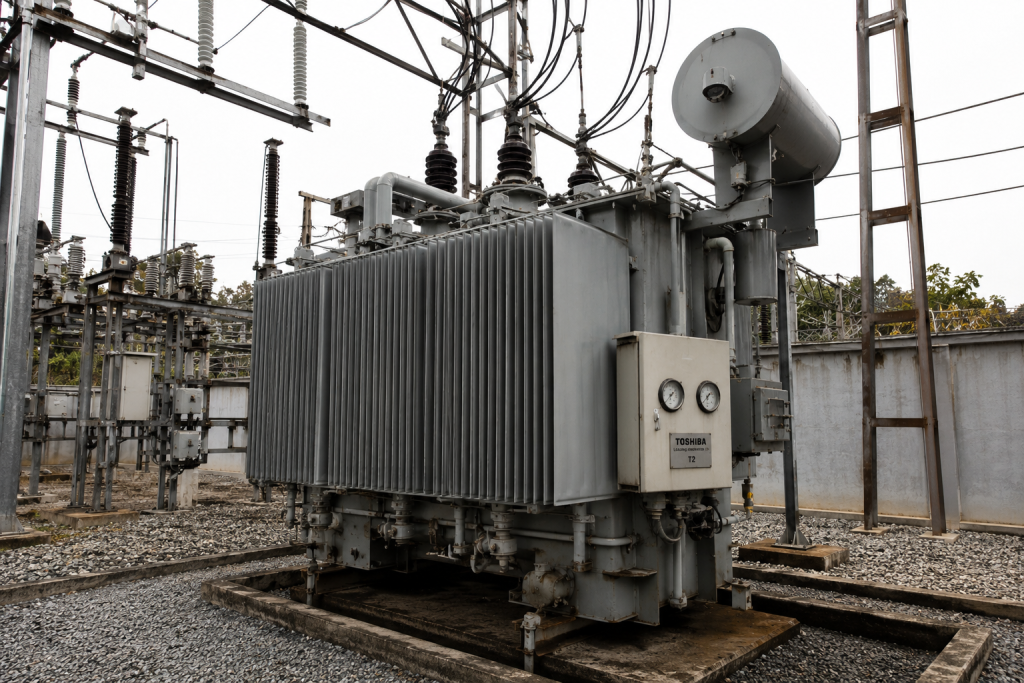
Oil-Immersed Power Transformer (500 kVA – 100 MVA)
Product Overview
The oil-immersed power transformer is a liquid-filled electrical device designed to step up or step-down voltage within transmission and primary distribution networks. Utilizing high-grade mineral oil or alternative dielectric fluids for both electrical insulation and thermal dissipation, this transformer operates continuously under heavy electrical loads. It serves as a core infrastructure asset in utility substations, renewable energy generation farms, and industrial manufacturing complexes, providing reliable voltage conversion and galvanic isolation across high-voltage circuits.
Key Features
1.High-Grade Dielectric Fluid Cooling: The internal core and coil assembly is completely submerged in insulating oil, which functions simultaneously as a primary dielectric barrier and a high-efficiency thermal conductor, preventing localized overheating during peak load conditions.
2.Low-Loss CRGO Magnetic Core: Built using cold-rolled grain-oriented (CRGO) silicon steel laminations with advanced step-lap joint technology. This minimizes core magnetization current, hysteresis, and eddy current losses, ensuring high operational efficiency.
3.High Short-Circuit Mechanical Withstand: Windings are constructed from high-conductivity electrolytic copper and mechanically braced with high-density pressboard and axial clamping rings to withstand severe electrodynamic forces during external grid short-circuits.
4.Comprehensive Protective Accessories: Standard configuration includes a Buchholz relay for internal fault gas detection, a pressure relief device (PRD) for over-pressure protection, winding and oil temperature indicators (WTI/OTI), and a magnetic oil level gauge.
5.Multiple Cooling Configurations: Engineered to support various cooling classes—including ONAN (Oil Natural Air Natural), ONAF (Oil Natural Air Forced), and OFAF (Oil Forced Air Forced)—to match specific thermal dissipation requirements of the installation site.
Technical Specifications
1.Rated Power Capacity: 500 kVA to 100 MVA
2.Primary Voltage Range: 11 kV, 22 kV, 33 kV, 66 kV, 110 kV, 132 kV, 220 kV (Customizable)
3.Secondary Voltage Range: 400V up to 66 kV
4.Frequency: 50 Hz / 60 Hz
5.Vector Group: Dyn11, YNyn0, YNd11 (Compliant with IEC 60076)
6.Cooling Method: ONAN / ONAF / OFAF
7.Insulation Class: Class A (Mineral Oil / Synthetic Ester Fluid)
8.Impedance Voltage: 6% to 14% (Engineered to system requirements)
9.Applicable Standards: IEC 60076, IEEE C57.12.00, ANSI, GOST
Primary Applications
1.Utility Substation Grid Interconnection: Voltage step-up at power generation plants and step-down at regional transmission substations.
2.Renewable Energy Integration: Stepping up low inverter voltages from utility-scale solar farms or wind turbine arrays to medium/high-voltage transmission levels.
3.Heavy Industrial Facilities: Supplying high-capacity, stable electrical power to steel mills, chemical processing plants, and mining sites.
4.Railway and Traction Power Systems: Providing dedicated voltage levels for heavy-duty electric rail transportation networks.
What is the function of the oil in an oil-immersed transformer?
The insulating oil serves two primary functions: electrical insulation and cooling. Electrically, it fills microscopic gaps and possesses a high dielectric breakdown strength, preventing electrical arcs between high-voltage components. Thermally, it absorbs heat generated by the copper windings and iron core, circulating it toward the tank walls and radiators to dissipate into the atmosphere.
How does an oil-immersed transformer dissipate heat?
Heat generated inside the core and coils is transferred to the surrounding dielectric oil. As the oil warms up, it rises via natural convection toward the top of the tank and flows through external radiators or cooling fins. As the oil cools down by transferring heat to the ambient air, it descends back to the bottom of the tank, creating a continuous thermal convection loop (ONAN).
Why do oil-immersed transformers require regular Dissolved Gas Analysis (DGA)?
Dissolved Gas Analysis (DGA) is a crucial preventive diagnostic test. When internal faults occur—such as localized overheating, partial discharge, or minor electrical arcing—they break down the insulating oil and cellulose paper, releasing specific hydrocarbon gases into the oil. Analyzing the type and concentration of these gases allows maintenance teams to identify developing faults before a catastrophic failure occurs.
What is the difference between mineral oil and synthetic ester fluid in transformers?
Traditional mineral oil is petroleum-based, highly cost-effective, and possesses excellent dielectric properties, but it has a lower fire point (around 160°C). Synthetic or natural ester fluids are high-fire-point, biodegradable alternatives (fire point above 300°C). Esters are chosen for environmentally sensitive locations or indoor/underground installations where fire safety and ecological protection are mandatory.
What is the typical lifespan of an oil-immersed power transformer?
With proper load management, regular oil filtration, and routine diagnostic testing (such as DGA and moisture content checks), an oil-immersed power transformer has an expected operational lifespan of 30 to 40 years. The primary factor limiting its lifespan is the thermal degradation of the solid cellulose paper insulation over time.