- 24/7 Industrial Support Available
- +86(512)58990319
- vp@jsxtbkj.com
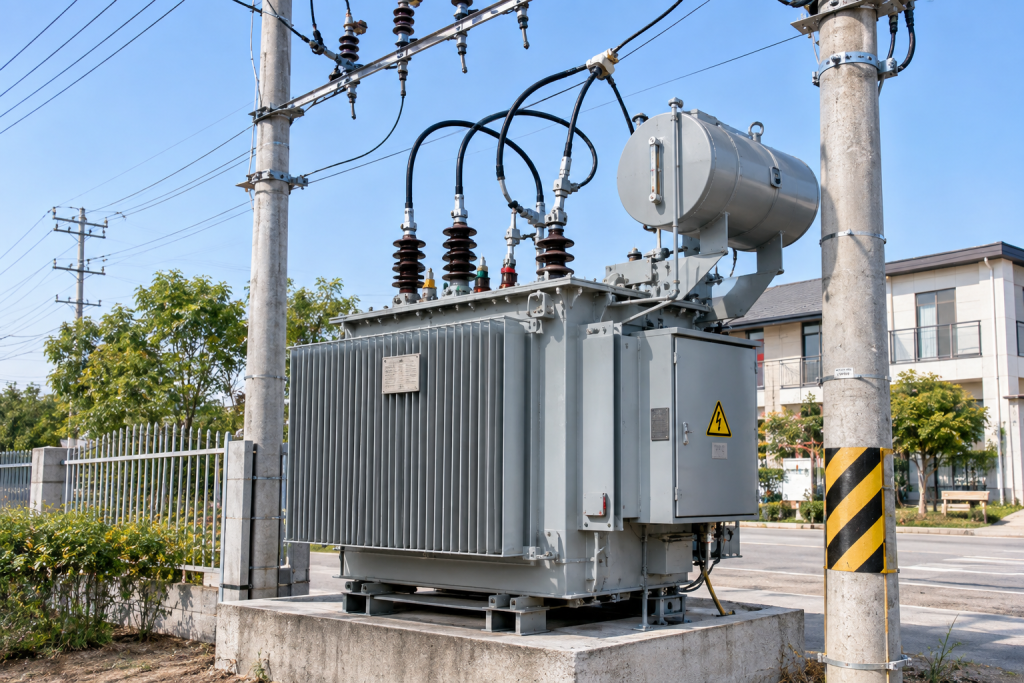
Oil-Immersed Distribution Transformer (50 kVA – 3150 kVA)
Product Overview
The distribution transformer is a step-down electrical transformer that converts medium voltage from the utility transmission grid to the low utilization voltage required by end-user consumers. Installed at the final stage of the electrical power system, this unit is engineered to operate efficiently under highly variable daily load cycles. It utilizes a high-permeability magnetic core and low-resistance windings to minimize both constant iron losses and variable copper losses, ensuring stable power delivery to residential, commercial, and light industrial electrical networks.
Key Features
1.Optimized Energy Efficiency: The magnetic core is constructed from cold-rolled grain-oriented (CRGO) silicon steel or amorphous metal alloys. This design minimizes hysteresis and eddy current losses (no-load losses), meeting stringent global energy efficiency mandates such as EU Eco-design Tier 2 and DOE 2016.
2.Hermetically Sealed Tank: The core and coil assembly is completely enclosed in a fully welded, hermetically sealed tank with corrugated cooling fins. This eliminates the need for a traditional conservator tank and prevents the insulating oil from contacting atmospheric oxygen and moisture, effectively eliminating oil sludging and reducing maintenance.
3.High Tolerance for Unbalanced Loads: Standardized with a Dyn11 or Dyn1 vector group configuration. The primary Delta connection allows third-harmonic currents to circulate within the winding, while the secondary Star (Wye) connection provides a neutral point to supply heavily unbalanced single-phase loads without causing voltage distortion.
4.Off-Circuit Tap Changer (OCTC): Equipped with a manual 3-position or 5-position tap changer (typically ±2.5% and ±5%) on the high-voltage side. This allows operators to adjust the secondary voltage output to compensate for permanent voltage drops in the primary supply line when the transformer is de-energized.
5.Short-Circuit Mechanical Integrity: Low-voltage windings are typically constructed using copper or aluminum foil/sheet instead of round wires. Foil winding eliminates axial short-circuit forces and distributes thermal stresses evenly, preventing winding deformation during external fault conditions.
Technical Specifications
1.Rated Power Capacity: 50 kVA to 3150 kVA
2.Primary Voltage: 11 kV, 15 kV, 22 kV, 33 kV, 34.5 kV (Customizable up to 36 kV)
3.Secondary Voltage: 400V, 415V, 433V (Three-Phase) / 230V, 240V (Single-Phase)
4.Frequency: 50 Hz / 60 Hz
5.Cooling Method: ONAN (Oil Natural Air Natural)
6.Vector Group: Dyn11, Dyn5, Yyn0
7.Insulation Class: Class A (105°C)
8.Dielectric Fluid: Mineral Oil (IEC 60296) or Biodegradable Ester Fluid (IEC 62770)
9.Installation Type: Pole-mounted (up to 315 kVA) or Ground-mounted / Pad-mounted
10.Applicable Standards: IEC 60076, ANSI/IEEE C57.12.00, EN 50588-1, IS 1180
Primary Applications
1.Public Utility Grids: Pole-mounted or compact substation installations providing low-voltage power to residential neighborhoods and urban commercial districts.
2.Industrial Plants: Serving as secondary distribution units within factories to supply localized power to motors, HVAC systems, and facility lighting.
3.Commercial Buildings: Installed in basements or electrical rooms of office towers, shopping malls, and hotels to step down grid voltage for internal distribution.
4.Agricultural Operations: Supplying stable 3-phase or single-phase power to irrigation pumps, grain dryers, and remote farming facilities.
What is the difference between a power transformer and a distribution transformer?
Power transformers are used in high-voltage transmission networks, operate at near 100% constant load, and are designed to achieve maximum efficiency at full load. Distribution transformers are used in low-voltage distribution networks, operate with highly fluctuating loads (high during the day, low at night), and are specifically designed to achieve maximum efficiency at around 50% to 70% of their rated load.
Why are distribution transformers designed for maximum efficiency at 50% load?
Because distribution transformers supply residential and commercial areas, they rarely operate at full capacity 24 hours a day. The load fluctuates significantly. Designing the transformer so that its fixed iron losses equal its variable copper losses at approximately 50% load ensures the highest overall all-day energy efficiency, minimizing wasted electricity across the grid.
What is the purpose of the corrugated fins on the transformer tank?
The corrugated steel fins serve two critical purposes. First, they dramatically increase the surface area of the tank, allowing the hot insulating oil to dissipate heat effectively into the ambient air (ONAN cooling). Second, the fins are flexible; they expand outward when the internal oil volume increases due to heating and contract when the oil cools, compensating for pressure changes in a hermetically sealed unit without requiring an external expansion tank.
Why is the Dyn11 vector group most commonly used for distribution transformers?
The “D” (Delta) primary connection traps third-harmonic currents, preventing them from flowing back into the high-voltage grid and causing interference. The “yn” (Star/Wye with neutral) secondary connection provides a solid neutral point. This allows the transformer to safely supply mixed three-phase (industrial) and single-phase (residential) loads, effectively handling severe load imbalances across the phases without voltage instability.
How often does a hermetically sealed distribution transformer require maintenance?
Hermetically sealed distribution transformers are generally considered low-maintenance or maintenance-free regarding the dielectric fluid. Because the oil never comes into contact with the outside atmosphere, it does not absorb moisture or oxidize. Standard maintenance is limited to annual visual inspections for leaks, cleaning the external bushings, and verifying the operation of the pressure relief valve and oil level indicator.