- 24/7 Industrial Support Available
- +86(512)58990319
- vp@jsxtbkj.com
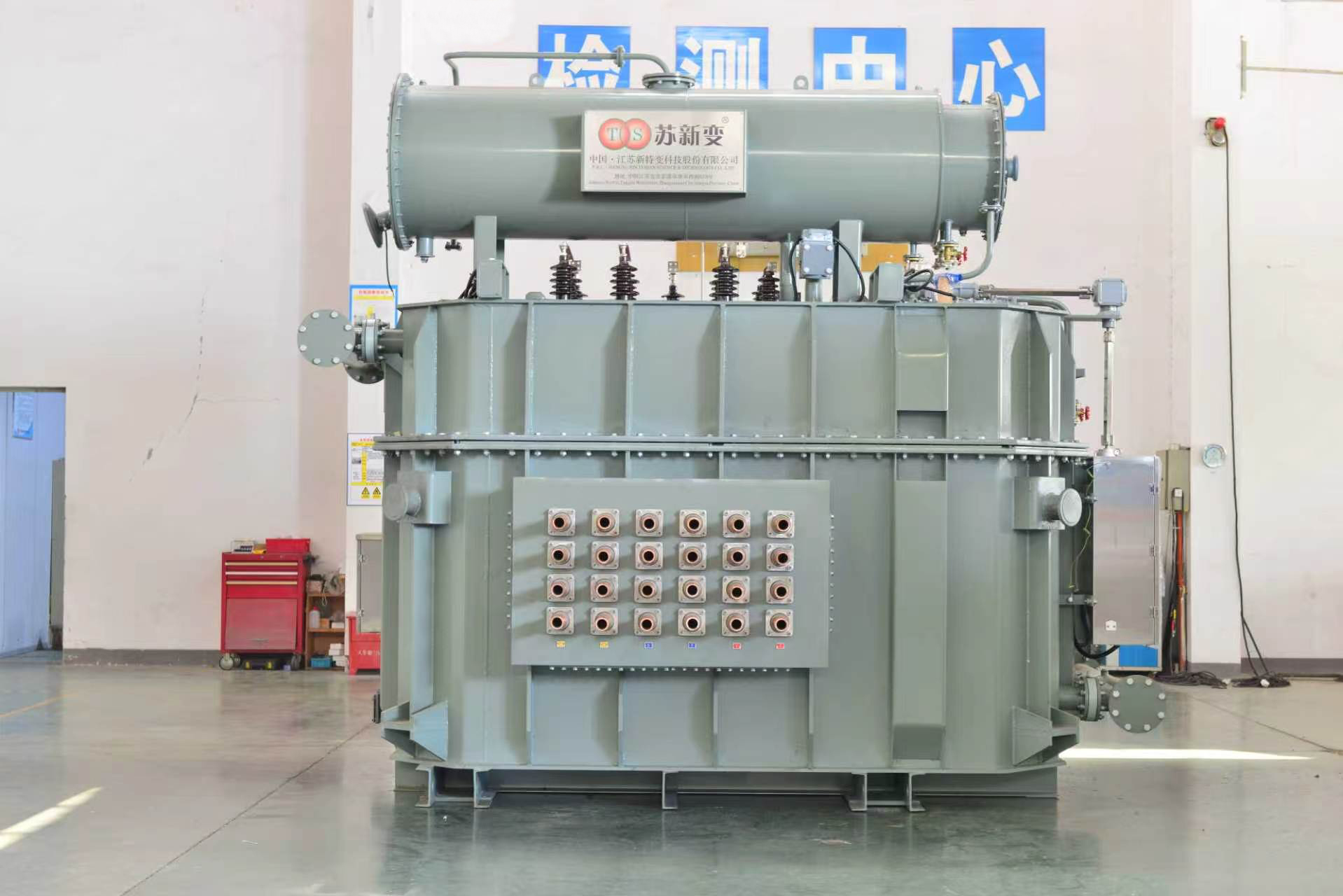
Industrial Furnace Transformer (EAF / SAF / LRF)
Product Overview
The furnace transformer is a highly specialized electrical transformer engineered to supply power to industrial metallurgical furnaces, including Electric Arc Furnaces (EAF), Ladle Refining Furnaces (LRF), and Submerged Arc Furnaces (SAF). Unlike standard grid transformers, this unit is designed to step down high transmission voltages to extremely low secondary voltages (typically 50V to 1500V) while delivering exceptionally high secondary currents (up to 150,000 amperes). It is structurally reinforced to withstand the severe mechanical and thermal stresses caused by frequent short-circuit conditions, voltage fluctuations, and heavy harmonic distortion inherent in arc-melting processes.
Key Features
1.Exceptional Short-Circuit Withstand Capability: The core and winding assemblies are mechanically reinforced using heavy-duty clamping structures and high-density pressboard insulation. This structural integrity prevents coil deformation during the daily, repetitive short-circuit events that occur during arc striking and scrap metal cave-ins.
2.Low Voltage, High Current Design: Secondary windings are constructed using multiple parallel copper conductors or continuous transposed cables (CTC) to handle massive currents safely. Low-voltage busbars are specifically routed to minimize stray losses and localized overheating.
3.Wide Voltage Regulation Range: Equipped with heavy-duty On-Load Tap Changers (OLTC) or Off-Circuit Tap Changers (OCTC), allowing operators to adjust secondary voltages across multiple fine steps. This wide regulation range is critical for controlling power input and arc length throughout different phases of the melting cycle.
4.Harmonic and Overvoltage Protection: The insulation system is graded to withstand transient overvoltages generated by the arc load. Electrostatic shields are placed between primary and secondary windings to prevent high-frequency transients from passing into the primary grid.
5.Integrated Series Reactor (Optional): For EAF applications, an internal or external series reactor can be integrated into the tank to provide additional impedance. This stabilizes the electric arc during the initial melting phase and limits extreme short-circuit currents.
Technical Specifications
1.Rated Power Capacity: 5 MVA to 300 MVA
2.Primary Voltage: 33 kV, 66 kV, 110 kV, 220 kV (Customizable up to 400kV)
b50 V to 1500 V (Regulated via tap changer)
3.Secondary Current Capacity: 10 kA to 150 kA (per phase)
4.Cooling Method: OFWF (Oil Forced Water Forced), ODWF (Oil Directed Water Forced), ONAF
5.Tap Changer Type: OLTC (On-Load) or OCTC / NLTC (Off-Circuit)
6.Number of Tap Steps: Up to 33 steps for precise power control
7.Impedance Voltage: 4% to 12% (Transformer only) / Up to 25% (With series reactor)
8.Phase Connection: Three-phase or Single-phase (depending on furnace configuration)
9.Applicable Standards: IEC 60076-1, IEC 60076-11, IEEE/ANSI C57.12.00, EN 50216
Primary Applications
1.Electric Arc Furnaces (EAF): Scrap steel melting and primary steel production.
2.Submerged Arc Furnaces (SAF): Smelting of ferroalloys (ferrosilicon, ferromanganese), silicon metal, and calcium carbide.
3.Ladle Refining Furnaces (LRF): Secondary metallurgy for desulfurization, temperature adjustment, and steel alloying.
4.Induction Furnaces: Power supply for non-ferrous and specialized ferrous alloy melting operations.
How is a furnace transformer different from a standard power transformer?
Standard power transformers operate with relatively steady loads and low currents. Furnace transformers are subjected to extreme operating conditions, including daily repetitive short circuits (during arc ignition), highly asymmetrical loads, and severe harmonic distortion. Consequently, they feature drastically reinforced mechanical clamping, lower impedance design, and specialized low-voltage/ultra-high-current secondary windings.
Why do furnace transformers require an OFWF (Oil Forced Water Forced) cooling system?
Due to the extremely high currents (often exceeding 100,000 amperes) flowing through the secondary windings, furnace transformers generate significant $I^2R$ (copper) losses and heat. OFWF cooling systems utilize a heat exchanger where transformer oil is pumped through water-cooled tubes, providing a much higher heat dissipation rate than standard air-cooling (ONAN/ONAF) in restricted industrial melt-shop environments.
What is the purpose of a series reactor in an EAF transformer?
A series reactor adds inductive reactance to the electrical circuit. In an Electric Arc Furnace, this added impedance is crucial during the bore-down (initial melting) phase to limit the magnitude of short-circuit currents when the electrodes directly touch the scrap steel, and to provide the electrical stability necessary to maintain a continuous arc.
How often does the tap changer in a furnace transformer need maintenance?
The tap changer in a furnace transformer operates much more frequently than in a grid transformer—often hundreds of times per day to adjust arc power. If a traditional oil-type OLTC is used, oil filtration and contact inspection are required annually or after a specific number of operations (e.g., 50,000). Modern vacuum-type OLTCs significantly extend maintenance intervals to 300,000 operations or more, as the arc is extinguished in a vacuum bottle rather than in the insulating oil.
Why is secondary voltage so low in furnace transformers?
The melting process relies on generating massive amounts of heat through an electric arc or electrical resistance. According to Joule’s law, heat generation is proportional to the square of the current. Therefore, furnace transformers step the voltage down to very low levels to allow extremely high currents to flow safely through the electrodes and the raw material, maximizing the heating effect.